

Executive Summary
The Maputo Protocol, which stands out as one of the most progressive women’s rights instruments, was adopted by the African Union on 11 July 2003 and came into force on 25 November 2005. The Protocol was developed to strengthen the provisions on gender equality which already existed in the African Charter on Human and Peoples’ Rights (African Charter or the Charter), and address the gaps in the Charter. Notably, the Maputo Protocol includes provisions prohibiting certain culturally harmful practices, including FGM, and recognises access to safe abortion (under specific conditions) as a women and girls’ right, thus exceeding the protections guaranteed under other international frameworks.
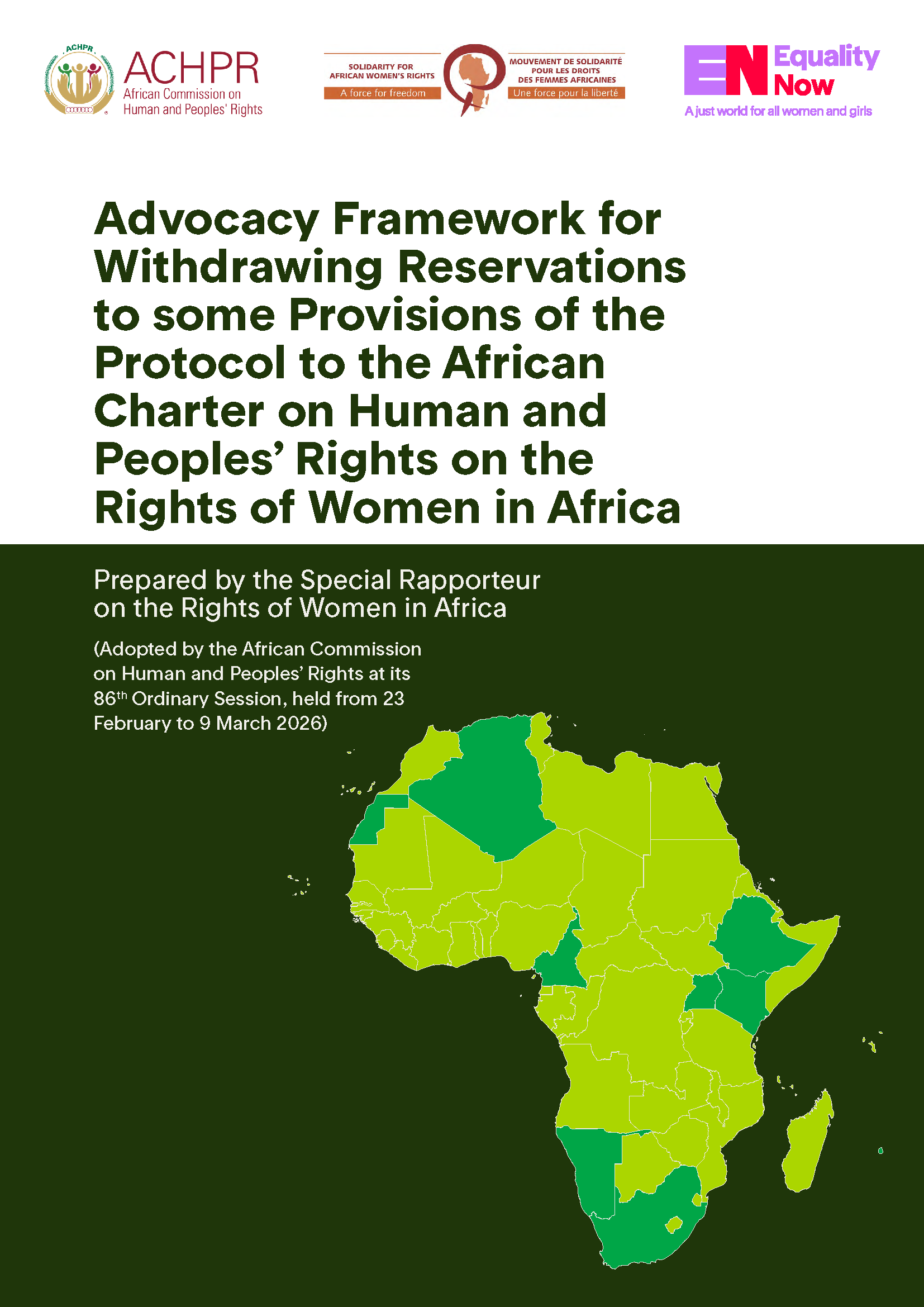
As of March 2026, forty-six (46) African Union Member States have ratified the Maputo Protocol, with nine States yet to ratify (Burundi, Chad, Egypt, Eritrea, Madagascar, Niger, Somalia, Sudan, Morocco). Moreover, nine (9) Member States (Algeria, Cameroon, Ethiopia, Kenya, Mauritius, Namibia, the Sahrawi Arab Democratic Republic, South Africa, and Uganda) have ratified the Protocol with reservations to some of the provisions. The reservations to the Maputo Protocol have the effect of limiting the obligations and accountability of reserving States. In practice, these reservations have a significant impact on the lives of women and girls, and often result in the reserving States failing to take the necessary steps to fully domesticate and implement specific provisions of the Protocol.
Through the ACHPR Resolution 632 (LXXXII) 2025, the African Commission on Human and Peoples’ Rights mandated the Special Rapporteur on the Rights of Women in Africa (SRRWA) to develop the Advocacy Framework for Withdrawing Reservations to some Provisions of the Protocol to the African Charter on Human and Peoples’ Rights on the Rights of Women in Africa (the Advocacy Framework). Beyond raising awareness for lifting reservations on some provisions of the Maputo Protocol, the Advocacy Framework aims to achieve the total withdrawal of these reservations to ensure full and uniform protection for women and girls’ rights in Africa, and to provide the necessary encouragement to Member States on the withdrawal of reservations to some provisions of the Maputo Protocol. Furthermore, it provides guidance to various key stakeholders to support the adaptation and strengthening of advocacy strategies aimed at promoting the withdrawal of reservations.
The Advocacy Framework is based on the key pillars of awareness raising, state accountability, and the preservation of the core provisions of the Maputo Protocol. The Advocacy Framework identifies the key stakeholders under each pillar and makes recommendations for each stakeholder’s role in the withdrawal of reservations.
For this Advocacy Framework to effectively meet its objectives, all stakeholders must take the necessary steps to actively promote and popularise it at national and regional levels to ensure the consistent application of its recommendations in policy and programmatic processes. This requires sustained collaboration among all stakeholders to strengthen awareness, ownership, and implementation efforts. Furthermore, advocacy towards the universal ratification of the Maputo Protocol without reservations must persist, to safeguard the integrity, object and purpose of the Protocol and ensure the full realisation and protection of the rights of women and girls in Africa.